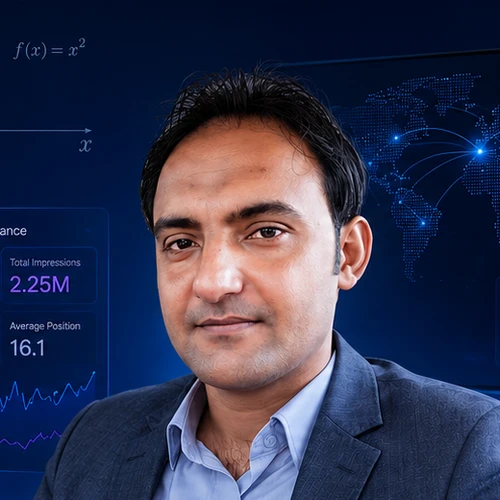
Mian Muhammad Asghar is a self-taught web developer and educational-technology founder with over 18 years of experience building free, accessible tools that help people learn. His career took him abroad early on, where he spent years building websites in his spare time around a full-time job — before eventually returning home and continuing to build with a fully remote, globally-minded approach. He founded OnlineCalculatorPlus.com in 2022, and later created DerivativeCalculus.com in November 2025.
The idea for DerivativeCalculus.com came from a simple frustration: the best calculus calculators online — tools like Symbolab and Mathway — had hidden step-by-step solutions behind paywalls. Students who needed help the most were being asked to pay. Mian built DerivativeCalculus.com to fix that — a completely free, step-by-step derivative calculator with no sign-up, no paywall, and no limits.
Today, the platform is maintained by Mian and a growing community of mathematics educators, bloggers, and enthusiasts who voluntarily review content to ensure accuracy. What started as a solo project now reaches students in 150+ countries every month — and has since grown into a small, active portfolio of independent projects (see the Projects & Ventures tab).
18+
Years in EdTech & Web Development
2022
OnlineCalculatorPlus.com Launched
Nov 2025
DerivativeCalculus.com Founded
50K+
Students Helped Monthly
150+
Countries Reached
3
Active Ventures Underway
My Story
The Beginning
If you asked when this story started, the honest answer isn't November 18, 2025 — the day DerivativeCalculus.com went live. It started more than a decade earlier, in internet cafés and on borrowed office computers, long before there was any product to launch.
I didn't come from a background of venture capital, computer science degrees, or startup accelerators. I came from curiosity — and a full-time job that had nothing to do with software. In the mid-2000s, I moved abroad to build a better future, the way so many ambitious people do: by starting from zero. During the day, I worked. At night, in whatever spare hours I could find, I taught myself to build websites — one broken project, one late night, one small win at a time.
Most of those early projects never became anything. They weren't supposed to. They were tuition — the unglamorous cost of learning a craft nobody was going to hand me.
"Every project taught me something. None of them had to succeed for that to be true."
The Question That Wouldn't Leave
By 2012, I was using Wolfram|Alpha regularly for freelance work — genuinely impressed by what the technology could do, and increasingly bothered by something else: the number of students across forums and communities saying the exact same thing. They loved the tool. They hated hitting a paywall the moment they actually needed the answer explained.
One question started forming, and it never really left: what if a platform could combine serious computational power with a genuinely educational mission — one where a student could learn, not just look something up, without a subscription standing in the way?
I even registered a domain for it. Then life did what life does — a demanding career, shifting priorities, a hundred reasonable excuses — and the domain eventually expired, unused. Most people would have let the idea go with it.
"I didn't forget it. For more than a decade, it just waited."
Starting, For Real
In October 2025, I made a decision that had been overdue for years: if I didn't build it now, I probably never would. No investors. No development team. No formal software engineering background. Just an idea that had outlasted every excuse not to build it.
On November 18, 2025, DerivativeCalculus.com went live. But the launch was never the achievement — it was the starting gun. What followed was months of near-daily building: interactive calculators, step-by-step educational guides, computational engines refined through real use, and the early groundwork for CalcMentor, an AI-assisted learning companion built to guide students rather than just hand them answers.
The filter for every feature was the same, every time: will this genuinely help a student understand calculus better? If the honest answer was no, it didn't ship — no matter how easy it would have been to add.
The Offers I Turned Down
The journey hasn't been a straight line up. There have been months with little or no revenue, long stretches of unpaid research and testing, and financially difficult decisions made without a safety net. There were real moments when selling the platform would have been the easier — even sensible — choice.
It became a genuine option, not a hypothetical one: as the platform grew, gained search visibility, and started appearing in results alongside some of the biggest names in online mathematics, people with real experience — founders, SEO specialists, educators, and buyers — started noticing. Some reached out with ideas. Some offered guidance. Some raised the possibility of acquiring it outright.
"Every time, I asked myself one question: if I sell today, will I regret never finding out how far this could go? The answer was always yes — so I kept building."
Those conversations mattered for a reason that had nothing to do with money. They were proof that people who evaluate platforms for a living saw real, current value in something built from nothing, by one person, with no team behind it.
What Comes Next
Today, the ambition is bigger than a single calculator. I want DerivativeCalculus.com to become one of the most trusted destinations in the world for learning calculus — not because of the size of a marketing budget, but because students, teachers, and now other builders can rely on what's actually there.
I'm also not building just one thing anymore. The same instinct that built DerivativeCalculus.com is now behind a small, growing portfolio of independent web products — proof that this was never a one-idea story. (See the "Projects & Ventures" tab for what's next.)
"This was never just a calculator website. It's proof that one idea, refused to be forgotten, is enough to start with."