Integral Calculator
Free step-by-step antiderivative calculator. Solve indefinite and definite integrals instantly — with full symbolic solutions, numerical evaluation, and Riemann sum visualization. Also works as an integration solver for AP Calculus, university courses, and engineering.
🧮 Solve Your Integral
💡 How to Use the Dual Engine
🚀 Fast Mode (default) — instant results for everyday integrals.
🎯 Accurate Mode — maximum precision for complex integrals, special functions (erf, gamma, Si, Ci), or when Fast Mode gives unexpected results.
- Click 🎯 Accurate Mode — wait for "✅ Accurate Mode ready" (~5–15 sec first load)
- Enter your function, set variable and limits, then click Calculate or press Enter
- Switch back to 🚀 Fast Mode anytime — silent, no popups
Note: Riemann visualization always uses Fast Mode for speed.
📌 Quick Examples — Click to Load
Computing integral symbolically...
Integration Result Fast
📝 Step-by-Step Solution
Complete Guide to Integration
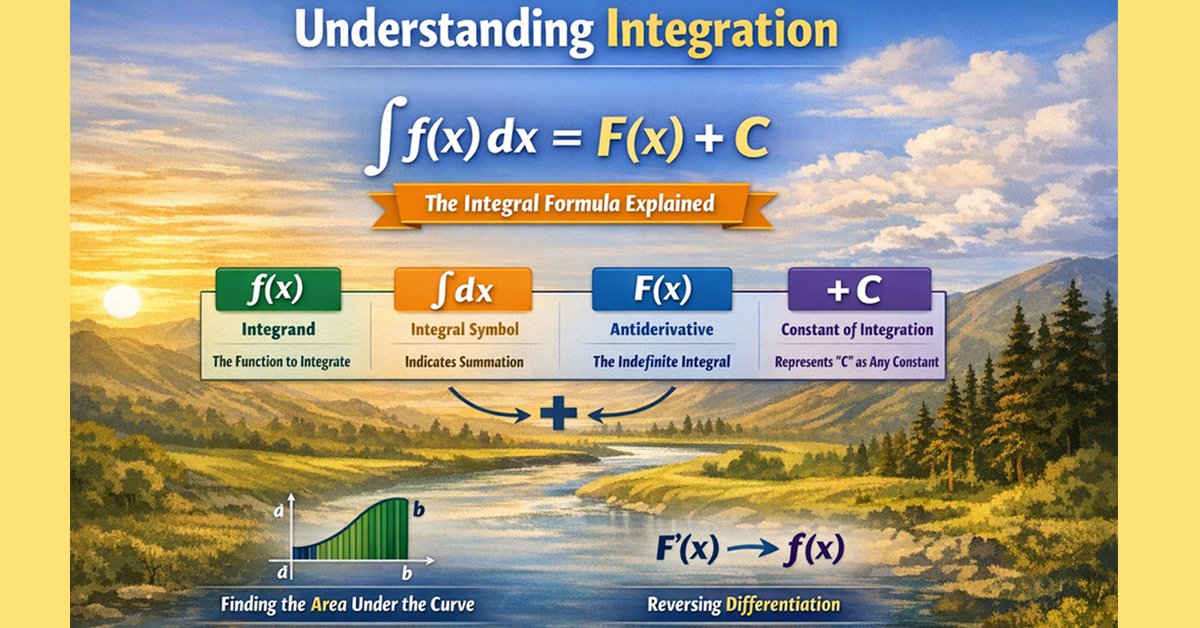
An integral is one of the two core concepts in calculus — the other being the derivative. While differentiation finds rates of change, integration finds accumulated quantities. Geometrically, a definite integral represents the net area under a curve between two bounds. This free integral calculator handles both indefinite integrals (antiderivatives) and definite integrals (area), with full step-by-step solutions and a dual-engine for maximum symbolic accuracy.
The Fundamental Theorem of Calculus
The bridge between differentiation and integration — the theorem that makes definite integrals computable:
where $F(x)$ is any antiderivative of $f(x)$, i.e. $F'(x) = f(x)$.
Indefinite vs. Definite Integrals
Indefinite integral (antiderivative): Written as $\int f(x)\,dx$, it returns a family of functions with constant $+C$. Example: $\int 2x\,dx = x^2 + C$.
Definite integral (area): Written as $\int_a^b f(x)\,dx$, it returns a specific number — the net signed area under the curve from $x=a$ to $x=b$. Example: $\int_0^2 2x\,dx = 4$.
Core Integration Rules
| Rule | Formula | Example |
|---|---|---|
| Power Rule | ∫ xⁿ dx = xⁿ⁺¹/(n+1) + C | ∫ x³ dx = x⁴/4 + C |
| Constant Multiple | ∫ a·f(x) dx = a·∫f(x) dx | ∫ 5x dx = 5x²/2 + C |
| Sum / Difference | ∫ (u ± v) dx = ∫u dx ± ∫v dx | ∫ (x+1) dx = x²/2 + x + C |
| Exponential | ∫ eˣ dx = eˣ + C | ∫ e^(2x) dx = e^(2x)/2 + C |
| Natural Log | ∫ 1/x dx = ln|x| + C | ∫ 1/(3x) dx = ln|x|/3 + C |
| Sine | ∫ sin(x) dx = −cos(x) + C | |
| Cosine | ∫ cos(x) dx = sin(x) + C | |
| Arctangent | ∫ 1/(x²+1) dx = arctan(x) + C |
Integration Techniques
U-Substitution: For integrals of the form $\int f(g(x))g'(x)\,dx$. Substitute $u = g(x)$, reducing to a simpler integral in $u$. Example: $\int 2x\cos(x^2)\,dx$ — let $u = x^2$, giving $\int \cos(u)\,du = \sin(u) + C = \sin(x^2) + C$.
Integration by Parts: For products of functions, using $\int u\,dv = uv - \int v\,du$. Ideal for $\int x e^x\,dx$, $\int x\sin(x)\,dx$, $\int \ln(x)\,dx$.
Partial Fractions: For rational functions, decompose into simpler fractions before integrating. Used for $\int \frac{1}{x^2-1}\,dx$.
What is a Riemann Sum?
Before the Fundamental Theorem, areas under curves were approximated by summing rectangles. A Riemann sum with $n$ rectangles over $[a,b]$:
Use the Visualize Area button above to see Left, Right, Midpoint, and Trapezoidal approximations converge to the exact value as $n$ increases.
Real-World Applications
- Physics: Displacement from velocity ($\int v(t)\,dt = s(t)$), work from force ($W = \int F\,dx$), electric charge from current.
- Engineering: Center of mass, moment of inertia, fluid pressure on a curved surface.
- Economics: Consumer surplus ($\int_0^{q^*}[D(q)-p^*]\,dq$), total revenue from marginal revenue.
- Biology: Population growth models, blood flow through arteries, drug concentration over time.
- Probability: Expected values ($E[X] = \int x f(x)\,dx$), cumulative distribution functions.
LSI Keywords: Related Concepts
This integral calculator covers: antiderivative calculator, indefinite integral solver, definite integral calculator, integration by parts calculator, u-substitution solver, area under curve calculator, Riemann sum calculator, fundamental theorem of calculus, integration rules, calculus integrator, integrate online with steps. Whether you're solving AP Calculus AB/BC problems, Calculus I–III coursework, or verifying engineering calculations, our dual-engine delivers verified results.
Frequently Asked Questions
An integral is the reverse of a derivative. If differentiating $F(x)$ gives $f(x)$, then integrating $f(x)$ returns $F(x) + C$. Geometrically, a definite integral gives the net signed area under the curve $y = f(x)$ between two bounds. Enter any function above to compute its integral instantly.
An indefinite integral returns a function family with constant $+C$: $\int 2x\,dx = x^2 + C$. A definite integral has bounds $a$ and $b$ and returns a number: $\int_0^2 2x\,dx = 4$. Toggle the "Definite Integral" switch in the calculator above to switch between modes.
$\int e^{x^2}\,dx$ has no elementary closed form — it cannot be expressed using standard functions. It is related to the imaginary error function (erfi). Switch to Accurate Mode to see the special-function representation. For practical purposes, numerical integration is typically used.
Since the derivative of any constant is zero, infinitely many antiderivatives exist for any function — each differing by a constant. $+C$ represents this family. For example, $x^2$, $x^2 + 5$, and $x^2 - 7$ all have derivative $2x$. $C$ is determined when you have an initial condition (a specific point the function passes through).
Yes. Both engines automatically detect and apply integration by parts for products like $\int x e^x\,dx$ and $\int x\sin(x)\,dx$, and u-substitution for composite functions. For the most reliable handling of complex substitution chains, switch to Accurate Mode.
A Riemann sum approximates a definite integral by dividing the area into rectangles (or trapezoids). After computing a definite integral, click "Visualize Area Under Curve" to see the approximation. Drag the slider to increase rectangles and watch the error shrink. Choose Left, Right, Midpoint, or Trapezoidal methods to compare their accuracy.
Fast Mode uses a client-side symbolic engine for instant results — best for standard polynomials, trig, exponential, and log functions. Accurate Mode loads a high-precision engine for complex integrals involving special functions, nested expressions, or when Fast Mode gives incomplete simplification. First load takes ~5–15 seconds; subsequent runs are instant.
Yes. In the definite integral limits, you can type pi for $\pi$, e for Euler's number, and basic expressions like 2*pi or pi/2. Improper integrals with infinity (inf or oo) work best in Accurate Mode which handles symbolic limits precisely.
External Resources
For deeper study, refer to OpenStax Calculus Volume 1 — Integration and Wolfram MathWorld on Integrals. Our solutions are cross-referenced against Stewart's Calculus (8th ed.) and Thomas' Calculus as part of our 4-layer verification methodology.
Built by DerivativeCalculus.com — Founded November 2025 by Mian Muhammad Asghar LinkedIn ↗, Dubai, UAE · 18+ years in educational technology
4-Layer Verification: Dual symbolic engine · Cross-checked against Stewart's & OpenStax · Community peer-reviewed · Public corrections log
✅ 99.7% accuracy rate · 50,000+ monthly students · 150+ countries · 100% free · No paywalls
About the Founder · Trust & Methodology · Editorial Policy · Report an Error