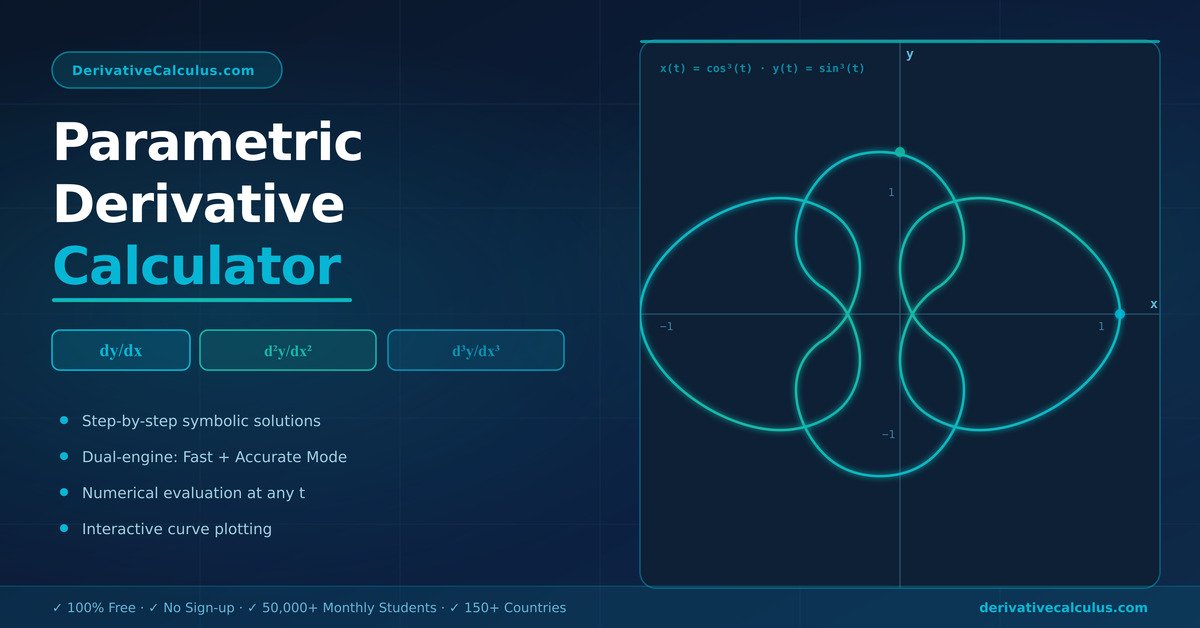
Parametric Derivative Calculator
Calculate the first derivative ($\frac{dy}{dx}$), second derivative ($\frac{d^2y}{dx^2}$), and third derivative of parametric equations $x(t)$ and $y(t)$ — with step-by-step solutions.
Enter Parametric Equations in terms of $t$
💡 How to Use the Dual Engine
🚀 Fast Mode (default) — instant results using the built-in symbolic engine. Best for everyday calculations.
🎯 Accurate Mode — uses a full high-precision symbolic engine for maximum accuracy. Best for complex expressions like t^t, deeply nested functions, or when Fast Mode gives unexpected results.
Steps to use Accurate Mode:
- Click 🎯 Accurate Mode — wait for "✅ Accurate Mode ready" (loads once, ~5–15 sec on first use)
- Enter your x(t) and y(t) equations (e.g.
cos(t),sin(t)), then click Calculate or press Enter - After first load, subsequent calculations are instant — no more waiting
- Switch back to 🚀 Fast Mode anytime — completely silent, no popups
Note: The plot always uses the Fast Mode engine for speed. All derivative computations (1st, 2nd, 3rd) use whichever engine you have selected.
📖 Supported Input Syntax — All Forms (click to expand)
⚠️ Use * for multiplication: write 2*t not 2t. Use ln(t) for natural log. Use exp(t) for eᵗ.
📌 Popular Examples — Click to Load
Computing derivatives symbolically...
Parametric Derivative Results Fast
Step-by-Step Breakdown
📈 Parametric Curve
Plot of $(x(t),\, y(t))$ · $t$ range: to
Drag to pan · Scroll to zoom · Double-click to reset · Click Save PNG to download
Parametric Derivatives: The Complete Guide
Parametric equations define coordinates $(x, y)$ in terms of a third variable — typically $t$, representing time or a curve parameter. Rather than writing $y = f(x)$ directly, parametric form expresses each coordinate separately: $x = x(t)$ and $y = y(t)$. Finding the slope $\frac{dy}{dx}$ and curvature $\frac{d^2y}{dx^2}$ requires a careful application of the chain rule. This parametric derivative calculator handles everything — first, second, and third derivatives — symbolically and numerically, with full step-by-step solutions.
First Parametric Derivative: $\frac{dy}{dx}$
The slope of a parametric curve at any point is the ratio of the rates of change of $y$ and $x$ — both with respect to the parameter $t$. This follows directly from the chain rule:
This formula is valid at any point where $\frac{dx}{dt} \neq 0$. When $\frac{dx}{dt} = 0$ and $\frac{dy}{dt} \neq 0$, the curve has a vertical tangent line and $\frac{dy}{dx}$ is undefined. When both are zero, the point is called a singular point requiring further analysis.
Second Parametric Derivative: $\frac{d^2y}{dx^2}$
The second derivative gives the concavity of the parametric curve. The most common mistake students make is computing $\frac{d^2y/dt^2}{d^2x/dt^2}$ — this is incorrect. The correct formula differentiates $\frac{dy}{dx}$ (which is itself a function of $t$) with respect to $t$, then divides by $\frac{dx}{dt}$ once more:
Third Parametric Derivative: $\frac{d^3y}{dx^3}$
The third derivative $\frac{d^3y}{dx^3}$ follows the same pattern. Differentiate $\frac{d^2y}{dx^2}$ (a function of $t$) with respect to $t$, then divide by $\frac{dx}{dt}$:
Tangent Lines to Parametric Curves
At parameter value $t_0$, the tangent line to a parametric curve has slope $m = \frac{dy}{dx}\Big|_{t=t_0}$ and passes through the point $(x(t_0), y(t_0))$. The tangent line equation is:
Use the Evaluate at t = field above to compute the numerical slope at any $t_0$ value. For the full tangent line equation, also enter $t_0$ to get both the slope and the point coordinates $(x(t_0), y(t_0))$.
Arc Length of Parametric Curves
The arc length of a parametric curve from $t = a$ to $t = b$ is given by the integral formula involving $\frac{dx}{dt}$ and $\frac{dy}{dt}$ — exactly the quantities our calculator computes symbolically:
Worked Example: Unit Circle
For $x(t) = \cos(t)$, $y(t) = \sin(t)$ — the classic unit circle parametrization:
- $\frac{dx}{dt} = -\sin(t)$, $\quad \frac{dy}{dt} = \cos(t)$
- $\frac{dy}{dx} = \frac{\cos(t)}{-\sin(t)} = -\cot(t)$
- $\frac{d}{dt}(-\cot(t)) = \csc^2(t)$
- $\frac{d^2y}{dx^2} = \frac{\csc^2(t)}{-\sin(t)} = -\csc^3(t)$
At $t = \pi/2$: $\frac{dy}{dx} = 0$ (horizontal tangent at the top of the circle), and $\frac{d^2y}{dx^2} = -1$ (concave down).
Worked Example: Cycloid
For $x(t) = t - \sin(t)$, $y(t) = 1 - \cos(t)$ — a cycloid traced by a point on a rolling circle:
- $\frac{dx}{dt} = 1 - \cos(t)$, $\quad \frac{dy}{dt} = \sin(t)$
- $\frac{dy}{dx} = \frac{\sin(t)}{1 - \cos(t)} = \cot\!\left(\frac{t}{2}\right)$
- The cusp at $t = 0$ (and $t = 2\pi$) corresponds to $\frac{dx}{dt} = 0$, giving a vertical tangent.
Common Mistakes to Avoid
- Never compute $\frac{d^2y/dt^2}{d^2x/dt^2}$ — this is incorrect and gives the wrong answer for the second parametric derivative.
- Always re-divide by $\frac{dx}{dt}$ in every successive derivative, not $\left(\frac{dx}{dt}\right)^2$ or $\left(\frac{dx}{dt}\right)^3$.
- When $\frac{dx}{dt} = 0$ and $\frac{dy}{dt} \neq 0$, the tangent is vertical and $\frac{dy}{dx}$ is undefined — our calculator flags this automatically.
- When both $\frac{dx}{dt} = 0$ and $\frac{dy}{dt} = 0$ simultaneously, the point is a singular point (like a cusp) requiring l'Hôpital's Rule or other analysis.
- Use
exp(t)for $e^t$, note^t, for best results in both engines.
LSI Keywords: Related Concepts
This parametric derivative calculator covers: dy/dx parametric equations, second derivative of parametric equations, d²y/dx² calculator, parametric differentiation, parametric equation derivative, parametric form derivatives, parametric curve tangent line, cycloid derivatives, ellipse parametric derivative, chain rule parametric form, first and second parametric derivatives with steps, dy dx parametric equations calculator, and third derivative of parametric equations. Whether you're solving AP Calculus BC problems, University Calculus II coursework, or researching differential geometry, this tool provides accurate symbolic results verified against Stewart's Calculus and OpenStax.
Frequently Asked Questions
A parametric derivative is the derivative $\frac{dy}{dx}$ of a curve defined by parametric equations $x(t)$ and $y(t)$. Rather than having $y$ as a direct function of $x$, both coordinates depend on a parameter $t$. The derivative is computed using the chain rule: $\frac{dy}{dx} = \frac{dy/dt}{dx/dt}$. This calculator handles first, second, and third parametric derivatives with full step-by-step solutions.
Differentiate $x(t)$ with respect to $t$ to get $\frac{dx}{dt}$, and differentiate $y(t)$ with respect to $t$ to get $\frac{dy}{dt}$. Then divide: $\frac{dy}{dx} = \frac{dy/dt}{dx/dt}$. This is valid as long as $\frac{dx}{dt} \neq 0$. Enter your $x(t)$ and $y(t)$ above and click Calculate to see the full worked solution.
The second derivative is $\frac{d^2y}{dx^2} = \frac{\frac{d}{dt}(dy/dx)}{dx/dt}$. You differentiate the first derivative $\frac{dy}{dx}$ (which is a function of $t$) with respect to $t$, then divide by $\frac{dx}{dt}$ again. A very common mistake is computing $\frac{d^2y/dt^2}{d^2x/dt^2}$ — this is incorrect and gives the wrong answer.
When $\frac{dx}{dt} = 0$, the parametric curve has a vertical tangent line and $\frac{dy}{dx}$ is undefined at that parameter value. If also $\frac{dy}{dt} = 0$ simultaneously, the point is a cusp or singular point (like the bottom of a cycloid). Our calculator detects vertical tangents automatically and displays a clear warning.
The third parametric derivative $\frac{d^3y}{dx^3} = \frac{\frac{d}{dt}(d^2y/dx^2)}{dx/dt}$. Differentiate the second derivative $\frac{d^2y}{dx^2}$ (which is a function of $t$) with respect to $t$, then divide by $\frac{dx}{dt}$ again. Select "First + Second + Third" in the dropdown above to compute all three derivatives at once.
The arc length of a parametric curve from $t = a$ to $t = b$ is $L = \int_a^b \sqrt{(dx/dt)^2 + (dy/dt)^2}\, dt$. Our calculator computes $\frac{dx}{dt}$ and $\frac{dy}{dt}$ symbolically in Step 1 of the solution — these are the exact components you need to set up the arc length integral.
Fast Mode uses a client-side symbolic engine for instant results — ideal for standard polynomials, trig, exponential, and logarithmic parametric equations. Most everyday calculations complete in under a second. Accurate Mode loads a high-precision symbolic computation engine for maximum accuracy, handling complex nested expressions, special functions, and cases where Fast Mode's simplification may be incomplete. First load of Accurate Mode takes ~5–15 seconds depending on your connection; all subsequent calculations in that session are instant. You can switch between modes silently at any time — no popups, no page reload.
At parameter value $t_0$, the slope is $m = \frac{dy}{dx}\big|_{t=t_0}$. The tangent line equation is $y - y(t_0) = m \cdot (x - x(t_0))$. Enter $t_0$ in the "Evaluate at t =" field to get the numerical slope. The point $(x(t_0), y(t_0))$ can be computed by substituting $t_0$ into your $x(t)$ and $y(t)$ functions directly.
Ready to Practice?
Download our free Parametric Derivative Worksheet — Parametric Derivatives Mastery Worksheet with 20 solved problems.
External Resources
For deeper reading on parametric differentiation, refer to OpenStax Calculus Volume 2 — Parametric Curves and the Wolfram MathWorld entry on Parametric Equations. Both verify the formulas implemented in this calculator. Our solutions are also cross-referenced against Stewart's Calculus (8th ed.) and Thomas' Calculus (14th ed.) as part of our 4-layer verification methodology.
Built by DerivativeCalculus.com — Founded November 2025 by Mian Muhammad Asghar LinkedIn ↗, Dubai, UAE · 18+ years in educational technology
4-Layer Verification: Dual symbolic engine (Fast + Accurate Mode) · Cross-checked against Stewart's Calculus, Thomas' Calculus & OpenStax · Community peer-reviewed by mathematics educators · Public corrections log maintained
✅ 99.7% accuracy rate · 50,000+ monthly students · 150+ countries · 100% free forever · No paywalls · No sign-up
About the Founder · Trust & Methodology · Editorial Policy · Report an Error