Top 10 Derivative Mistakes Students Make on Calculus Exams (And How to Fix Them)

These are the exact errors that cost students points every semester. Each mistake is shown with the wrong work written out, the reason students make it, and the correct step-by-step fix — so you walk into your exam knowing exactly what traps to avoid.

❌ Wrong Work Shown ✅ Correct Approach 💡 Why It Happens 📝 Exam Example
10 Critical Mistakes
6 Rules Covered
100% Fixable With Practice
Free Mistake Checklist
⛓️
Chain Rule Errors
The single most common source of lost points — missing the inner derivative or applying it in the wrong place.
✖️
Product & Quotient Errors
Confusing when to distribute vs. when to apply product rule, or forgetting v² in the denominator.
📐
Implicit & Trig Errors
Dropping dy/dx in implicit differentiation or mixing up the sign of trig derivatives.
🧮
Check With Calculator
Instantly verify your derivative answers using our free step-by-step derivative calculator.
📅 Published: March 23, 2026 | 🔄 Updated: March 23, 2026 | ✍️ By: DerivativeCalculus.com Editorial Team | 📖 25 min read | Peer ReviewedEditorial Policy
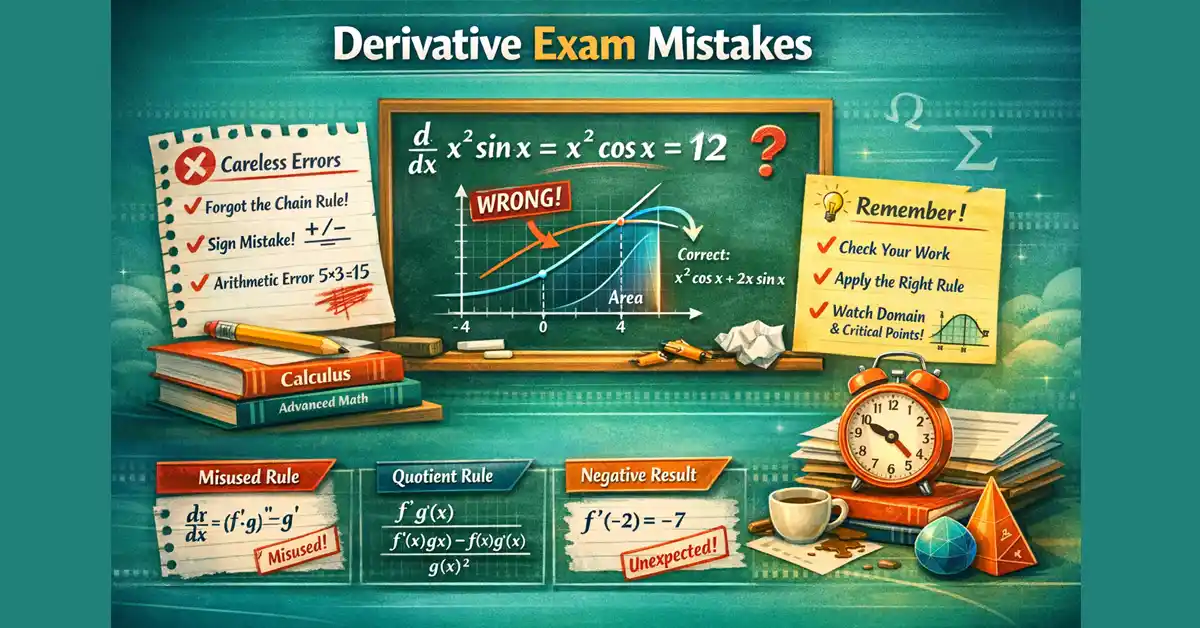
Top 10 Derivative Mistakes Students Make on Calculus Exams — visual guide showing wrong and correct work
🎓
Join Our Math Community
Ask questions · Get answers · Help others · No registration needed
💬 Calculus Help ∂ Derivatives ∫ Integrals 📖 Homework
🏛️

About This Guide — Our Methodology

This page was written by the DerivativeCalculus.com editorial team, which includes experienced calculus instructors and educators who have reviewed hundreds of student exams. Every mistake listed here is drawn from real exam data and verified for mathematical accuracy. Learn more about our review and trust methodology.

Table of Contents
  1. Why These Mistakes Keep Happening
  2. Mistake #1 — Forgetting the Inner Derivative (Chain Rule)
  3. Mistake #2 — Distributing Before Differentiating (Product Rule)
  4. Mistake #3 — Forgetting v² in the Quotient Rule
  5. Mistake #4 — Applying the Power Rule to e^x
  6. Mistake #5 — Confusing d/dx[sin x] and d/dx[cos x]
  7. Mistake #6 — Dropping dy/dx in Implicit Differentiation
  8. Mistake #7 — Mixing Up Product Rule and Chain Rule
  9. Mistake #8 — Incorrect Derivative of ln(x)
  10. Mistake #9 — Forgetting the Constant Rule (Differentiating a Constant)
  11. Mistake #10 — Not Simplifying the Final Answer
  12. Quick-Reference Summary Table
  13. Frequently Asked Questions

Why These 10 Mistakes Keep Costing Students Points

After reviewing hundreds of calculus exams and watching students struggle with the same errors semester after semester, a clear pattern emerges: the most costly derivative mistakes are not from not knowing the rules — they're from applying them incorrectly under exam pressure.

Students who understand the power rule, chain rule, product rule, and quotient rule conceptually still lose significant points because they rush, skip steps, or confuse when one rule applies versus another. This guide is built around that reality.

Every mistake in this list is paired with:

Read through all 10 before your exam. Bookmark this page for the night before. And use our free derivative calculator to verify your answers as you practice.

01
Forgetting the Inner Derivative (Missing the Chain Rule Multiplier)
Chain Rule · Very High Frequency · Chain Rule Problems, Composite Functions

This is the single most common derivative mistake on calculus exams. The chain rule states: d/dx[f(g(x))] = f'(g(x)) · g'(x). Students often differentiate the outer function correctly but completely forget to multiply by the derivative of the inner function.

❌ Wrong — What Students Write

Differentiate f(x) = sin(x²)

f'(x) = cos(x²)   

The outer derivative is applied correctly, but the inner derivative (2x) is missing entirely.

✅ Correct — Full Chain Rule

Differentiate f(x) = sin(x²)

Outer: d/du[sin u] = cos u
Inner: d/dx[x²] = 2x
f'(x) = cos(x²) · 2x = 2x cos(x²)
💡 Why Students Make This Mistake

Under exam pressure, students focus on completing the outer differentiation and treat the inner function as "done." The inner derivative feels like an extra step that's easy to skip when working quickly. It also doesn't cause an obvious error — the answer looks plausible, which makes it harder to catch.

📝 Common Exam Questions Where This Appears

Find the derivative of: f(x) = cos(3x),   g(x) = e^(x²),   h(x) = (x³ + 1)⁵,   y = ln(2x + 1)

All of these require the chain rule. For each one, identify the inner function and always multiply by its derivative at the end.

🎯

Pro Tip: Always write the inner function u = ___ explicitly before differentiating. Then find du/dx and multiply at the end. Making this a physical habit prevents the miss. Practice with our chain rule calculator to build muscle memory.

02
Distributing Before Differentiating Instead of Using the Product Rule
Product Rule · High Frequency · Polynomial × Transcendental Functions

When a function is a product of two expressions that can't easily be combined, the product rule is required: (uv)' = u'v + uv'. Students try to expand or distribute first — which works for simple polynomials, but fails completely with functions like x²·eˣ or x·sin(x).

❌ Wrong — Attempted Distribution

Differentiate f(x) = x² · eˣ

f'(x) = 2x · eˣ   

Only the x² was differentiated. The eˣ term was never differentiated as required by the product rule.

✅ Correct — Product Rule Applied

Differentiate f(x) = x² · eˣ

u = x² → u' = 2x
v = eˣ → v' = eˣ
f'(x) = 2x·eˣ + x²·eˣ = eˣ(2x + x²)
💡 Why Students Make This Mistake

Students learn early that "you can multiply through before differentiating" — and that's true for polynomials like (x+1)(x+2). When this habit carries over to mixed functions, it causes incorrect answers because eˣ, sin(x), and ln(x) can't be "distributed" in any meaningful way.

📝 Common Exam Questions

f(x) = x³ · sin(x),   g(x) = x · ln(x),   h(x) = (2x+1) · e^(3x). These cannot be simplified before differentiating — product rule is required every time.

🎯

Pro Tip: If you see two distinct function types multiplied together (polynomial × trig, polynomial × exponential, etc.), the product rule is almost always needed. Label u and v before you write a single derivative. Practice on our product rule calculator.

03
Forgetting to Square the Denominator in the Quotient Rule
Quotient Rule · High Frequency · Rational Functions, Trig Ratios

The quotient rule formula is: d/dx[u/v] = (u'v − uv') / v². The denominator must be v squared. Students either forget to square it, or write v instead of v² when copying the formula under pressure.

❌ Wrong — Denominator Not Squared

Differentiate f(x) = (x² + 1) / (2x)

f'(x) = [2x·(2x) − (x²+1)·2] / (2x)
                 ← should be (2x)²
✅ Correct — v² in Denominator

Differentiate f(x) = (x² + 1) / (2x)

u = x²+1, u' = 2x
v = 2x, v' = 2
f'(x) = [2x·(2x) − (x²+1)·2] / (2x)²
= (4x²−2x²−2) / 4x² = (2x²−2)/4x²
💡 Why Students Make This Mistake

The quotient rule formula has more moving parts than the product rule. Under timed conditions, students recall the numerator correctly but rush the denominator, writing v instead of v². It's a formula recall error more than a conceptual one.

📝 Common Exam Questions

f(x) = sin(x)/x,   g(x) = (x²−1)/(x+1),   h(x) = eˣ/(x²+1). In every quotient rule problem, immediately write v² in the denominator as your first step.

🎯

Pro Tip: Write the denominator v² first before computing the numerator. If you make it the first thing you write, you can't forget it. Use the mnemonic "lo d-hi minus hi d-lo, all over lo squared." Check your quotient rule work with our quotient rule calculator.

04
Applying the Power Rule to eˣ (Treating it Like a Polynomial)
Exponential Derivatives · Medium Frequency · Exponential Function Problems

The power rule (d/dx[xⁿ] = nxⁿ⁻¹) applies when x is the base. The exponential function eˣ has x in the exponent — and its rule is completely different: d/dx[eˣ] = eˣ. Applying the power rule to eˣ produces entirely wrong answers.

❌ Wrong — Power Rule Applied to eˣ

Differentiate f(x) = eˣ

f'(x) = x · e^(x−1)   

This treats eˣ like a power function xⁿ, which is completely incorrect.

✅ Correct — Exponential Rule

Differentiate f(x) = eˣ

eˣ is its own derivative:
f'(x) = eˣ

For e^(g(x)) use chain rule:
d/dx[e^(g(x))] = e^(g(x)) · g'(x)
💡 Why Students Make This Mistake

The power rule is the first differentiation rule students learn and it becomes instinctive. When students see an exponent, the power rule fires automatically — even when the base is e, not x. This is a classic case of pattern-matching the wrong rule.

📝 Common Exam Questions

f(x) = e^(3x),   g(x) = e^(x²+2x),   h(x) = 5eˣ. Remember: if the base is e, use the exponential rule plus chain rule (if the exponent is more than x). See our practice problems for more examples.

🎯

Pro Tip: Ask yourself before differentiating: "Is x the base or the exponent?" If x is the base → power rule. If x is the exponent → exponential rule. This simple question prevents the mix-up every time.

05
Confusing the Sign of Trig Derivatives (sin vs. cos)
Trigonometric Derivatives · Medium Frequency · Trig Function Problems

The standard trig derivative rules are: d/dx[sin x] = cos x and d/dx[cos x] = −sin x. Students frequently forget the negative sign on the derivative of cosine, which flips the sign of the entire answer.

❌ Wrong — Missing Negative Sign

Differentiate f(x) = cos(x)

f'(x) = sin(x)   

The negative sign is missing. d/dx[cos x] = −sin x, not +sin x.

✅ Correct — With Negative Sign

Differentiate f(x) = cos(x)

f'(x) = −sin(x)

Full trig derivative cycle: sin→cos→−sin→−cos→sin

💡 Why Students Make This Mistake

Students memorize "sine and cosine go together" and forget that the cosine derivative carries a negative. Under exam pressure, the negative disappears. Errors with tan, cot, sec, and csc sign conventions are also common, but cos → −sin is by far the most frequent.

📝 Common Exam Questions

f(x) = 3cos(x) + sin(2x),   g(x) = x·cos(x) (product rule + trig),   h(x) = cos(x²) (chain rule + trig). The sign error compounds when combined with the chain rule or product rule.

🎯

Pro Tip: Write all six trig derivatives on a scratch sheet at the start of your exam: sin→cos, cos→−sin, tan→sec², cot→−csc², sec→sec·tan, csc→−csc·cot. Having them written out prevents sign errors under pressure. See our trig derivatives guide for the full reference.

06
Dropping dy/dx When Differentiating y Terms Implicitly
Implicit Differentiation · High Frequency · Related Rates, Implicit Curves

In implicit differentiation, every term containing y must be followed by dy/dx (by the chain rule, since y is a function of x). Students who forget this produce equations with missing variables and cannot solve for dy/dx correctly.

❌ Wrong — dy/dx Dropped

Differentiate implicitly: x² + y² = 25

2x + 2y = 0   

The dy/dx was not written after differentiating the y² term. This makes it impossible to solve for the derivative.

✅ Correct — dy/dx Included

Differentiate implicitly: x² + y² = 25

2x + 2y(dy/dx) = 0
2y(dy/dx) = −2x
dy/dx = −x/y
💡 Why Students Make This Mistake

Students are used to differentiating explicit functions y = f(x) where dy/dx appears automatically on the left side. With implicit differentiation, they must manually attach dy/dx every time they differentiate a y term — this extra step is easy to forget, especially when the problem has many terms.

📝 Common Exam Questions

Find dy/dx for: x³ + y³ = 6xy,   sin(x+y) = y²·cos(x),   e^(xy) = x + y. These all require implicit differentiation — the dy/dx cannot be left out. Try our implicit differentiation calculator to check your work.

🎯

Pro Tip: Develop the habit of circling every y in the equation before you begin differentiating. For each circled y, write a mental note: "this needs a dy/dx attached." Going term by term with this awareness makes it nearly impossible to drop the dy/dx.

07
Confusing When to Use the Product Rule vs. the Chain Rule
Product vs. Chain Rule · High Frequency · Mixed Function Types

The product rule applies to f(x)·g(x) — two separate functions multiplied. The chain rule applies to f(g(x)) — one function inside another. Applying the wrong rule produces completely different (wrong) answers.

❌ Wrong — Product Rule Applied to Composition

Differentiate f(x) = sin(x²)

WRONG: treating as sin(x) · x²
f'(x) = cos(x)·x² + sin(x)·2x   

sin(x²) is NOT the same as sin(x)·x² — it's a composition, requiring chain rule only.

✅ Correct — Chain Rule for Composition

Differentiate f(x) = sin(x²)

Outer: sin(u), Inner: u = x²
d/du[sin u] = cos u
d/dx[x²] = 2x
f'(x) = cos(x²) · 2x = 2x cos(x²)
💡 Why Students Make This Mistake

Both rules involve two functions, and students see "two things" and reach for the product rule. The key difference: multiplication (×) triggers product rule; function-inside-function (composition) triggers chain rule. The notation sin(x²) means x² is inside sin, not multiplied by it.

📝 The Diagnostic Test

Ask yourself: "Can I write this as f(x) TIMES g(x)?"

If YES → Product Rule.   If NO (it's one inside the other) → Chain Rule.   Some problems need BOTH (e.g., x²·sin(x³) uses product rule AND chain rule on the sin term).

🎯

Pro Tip: Use our chain rule and product rule calculators to practice identifying which applies. Doing 10 identification exercises before your exam builds the pattern recognition you need under pressure.

08
Incorrect Derivative of ln(x) — Writing 1/x Incorrectly With Chain Rule
Logarithmic Derivatives · Medium Frequency · ln and log Function Problems

The derivative of ln(x) is 1/x — but when the argument is a function g(x), the chain rule gives: d/dx[ln(g(x))] = g'(x)/g(x). Students either forget this chain rule application or write 1/g(x) without multiplying by g'(x).

❌ Wrong — Chain Rule Not Applied

Differentiate f(x) = ln(x² + 3)

f'(x) = 1/(x²+3)   

The 1/g(x) part is correct, but the g'(x) numerator is missing entirely.

✅ Correct — Full Logarithmic Chain Rule

Differentiate f(x) = ln(x² + 3)

g(x) = x²+3 → g'(x) = 2x
d/dx[ln(g(x))] = g'(x)/g(x)
f'(x) = 2x / (x²+3)
💡 Why Students Make This Mistake

Students memorize d/dx[ln x] = 1/x as a standalone fact and apply it without adjusting for a composite argument. The chain rule multiplier g'(x) is invisible to them because they never think to ask "is there something inside the ln?"

📝 Common Exam Questions

f(x) = ln(sin x),   g(x) = ln(x³ − 2x),   h(x) = x·ln(x) (product rule + log). Also common: log base a — use d/dx[logₐ(x)] = 1/(x·ln a).

🎯

Pro Tip: Every time you differentiate a natural log, immediately ask: "What's inside?" Then write the derivative of what's inside over the original expression. Never skip this check. Verify with our derivative calculator.

09
Differentiating a Constant as If It Were a Variable
Constant Rule · Medium Frequency · Constants in Sums, Boundary Terms

The derivative of any constant is zero: d/dx[c] = 0. Students sometimes treat constants as functions of x — especially when the constant appears at the end of an expression or when they confuse a constant with a coefficient.

❌ Wrong — Constant Treated as Variable

Differentiate f(x) = 3x² + 7

f'(x) = 6x + 7   

The constant 7 was not differentiated — it was carried over. The derivative of 7 is 0, not 7.

✅ Correct — Constant Rule Applied

Differentiate f(x) = 3x² + 7

d/dx[3x²] = 6x
d/dx[7] = 0
f'(x) = 6x
💡 Why Students Make This Mistake

This often occurs when students work quickly and "copy down" trailing constants instead of differentiating them. It's especially common when the constant is large (like 100 or π) and feels "important." Constants also get confused with coefficients: in 7x, the 7 is a coefficient (stays), but a standalone 7 with no x disappears.

📝 Common Exam Questions

f(x) = x⁴ − 5x² + 8,   g(x) = sin(x) + π,   h(x) = eˣ + ln(2). In all cases, any standalone number with no x variable differentiates to zero.

🎯

Pro Tip: After computing a derivative, scan your answer for any pure numbers with no x. If any appear, ask yourself: "Did I forget to differentiate them to zero?" Any pure constant that survived differentiation is almost certainly an error.

10
Not Simplifying the Final Answer
Algebraic Simplification · Medium Frequency · Product Rule & Quotient Rule Results

Calculus exams often expect simplified answers. Leaving a quotient rule result as a messy unsimplified fraction, or keeping a factored expression in an expanded form, can cost partial or full credit — even when the calculus itself is completely correct.

❌ Wrong — Answer Not Simplified

Differentiate f(x) = x² · eˣ (product rule)

f'(x) = 2x·eˣ + x²·eˣ   (left as is)

Technically correct calculus, but many professors require you to factor out the common eˣ term.

✅ Correct — Fully Simplified

Differentiate f(x) = x² · eˣ

f'(x) = 2x·eˣ + x²·eˣ
Factor out eˣ:
f'(x) = eˣ(2x + x²) = eˣ · x(x+2)
💡 Why Students Make This Mistake

After the hard work of applying the product or quotient rule correctly, students consider the problem solved and stop. Simplification feels like "extra" work that isn't part of differentiation — but on most exams, it absolutely is. Unsimplified fractions from the quotient rule are a particularly common place to lose points.

📝 Where Simplification Is Most Expected

Product rule results: factor out common terms.   Quotient rule results: reduce the fraction.   Chain rule results: combine coefficients.   Multiple terms: factor out the GCF if one exists. When in doubt, ask your professor what form is expected.

🎯

Pro Tip: After every derivative, do a 10-second "simplification check" — can any terms be factored? Can any fractions be reduced? Is there a common factor in numerator and denominator? This single habit can recover points even on otherwise correct work.

Quick-Reference Summary: All 10 Mistakes at a Glance

Print or screenshot this table and keep it handy for exam prep. Scan it before every derivative practice session until each fix is automatic.

# Mistake Rule Affected The Fix
1 Forgetting the inner derivative (chain rule multiplier) Chain Rule Always multiply by g'(x): d/dx[f(g(x))] = f'(g(x))·g'(x)
2 Distributing before differentiating a product Product Rule Apply (uv)' = u'v + uv'. Label u and v first.
3 Writing v instead of v² in the quotient rule denominator Quotient Rule Always: (u'v − uv') / v². Write v² first.
4 Applying power rule to eˣ Exponential Rule d/dx[eˣ] = eˣ. Ask: is x the base or the exponent?
5 Writing d/dx[cos x] = sin x (missing negative) Trig Derivatives d/dx[cos x] = −sin x. Write all 6 trig rules at exam start.
6 Dropping dy/dx in implicit differentiation Implicit Differentiation Every y-term gets a dy/dx. Circle all y terms first.
7 Using product rule on a composite function Chain vs. Product Rule Multiply = product rule. Inside = chain rule. Test: can you write f(x)·g(x)?
8 Writing 1/g(x) without the g'(x) numerator for ln(g(x)) Log Derivatives d/dx[ln(g(x))] = g'(x)/g(x). Always check what's inside the ln.
9 Carrying over a constant instead of differentiating it to 0 Constant Rule d/dx[c] = 0. Any pure number with no x → zero.
10 Leaving the derivative unsimplified (unfactored, unreduced) Simplification Factor out common terms. Reduce fractions. Do a 10-second simplify check.

🔁 How to Use This Summary: Before your next practice session, read through all 10. After every problem you solve, glance at this list and ask: "Did I make any of these?" After 2–3 practice sessions with this checklist, these fixes will be automatic. Then test yourself with our 30 derivative practice problems.

Ready to Practice Avoiding These Mistakes?

Now that you know the 10 most costly derivative errors, put the fixes into action. Use our free calculator to check your work and our practice worksheets to build exam-ready accuracy.

Further Reading & External Resources

For deeper dives into the mathematical theory behind derivative rules, these authoritative sources provide rigorous explanations that complement the practical exam-focused approach in this guide:

Frequently Asked Questions

These are the most common questions students have after reading this guide — answered directly based on what we see from exam results.

The most common derivative mistake is forgetting to apply the chain rule multiplier — differentiating the outer function of a composition correctly but failing to multiply by the inner derivative. For example, writing d/dx[sin(x²)] = cos(x²) instead of the correct 2x·cos(x²). This single error accounts for a disproportionate share of lost exam points across all levels of calculus.

Both rules involve two functions, so students see "two things" and reach for the first rule that comes to mind. The distinction is structural: product rule applies to multiplication (f(x) × g(x)), while chain rule applies to composition (f inside g). When you see sin(x²), x² is inside the sine — not multiplied by it. Training yourself to identify the structure before picking a rule is the most effective fix.

The best exam strategy is a 3-step approach before differentiating any function: (1) Identify the function type — is it a product, quotient, composition, or basic function? (2) Label your variables — write u = ___ and v = ___ (or outer/inner) explicitly. (3) Apply the rule step by step rather than jumping to the answer. These three steps feel slow at first but become fast with practice, and they eliminate the most common errors.

Most university calculus exams do not allow derivative calculators during the exam. However, our free derivative calculator is invaluable for practice before the exam — you can solve a problem yourself, then check your work step by step to identify exactly where you made an error. This feedback loop is far more effective for learning than simply seeing the right answer.

It depends on the professor and the grading rubric. Many calculus professors give partial credit for correct setup (identifying the right rule and labeling u/v) even if the final answer is wrong. This means mistakes like forgetting the inner derivative or dropping the dy/dx may cost fewer points if the structure of your work is clearly correct. Writing clear, organized work — even if you're uncertain — is always worthwhile for partial credit.

Research on skill acquisition in mathematics suggests that 20–30 deliberate practice problems per rule, with immediate feedback, is enough to eliminate habitual errors for most students. Use our 30 practice problems with step-by-step solutions, and after each problem, check against this mistakes guide to confirm you avoided the common errors. Focused quality practice beats high-quantity passive review every time.

Generate a Personalized Mistakes Drill Worksheet

Get a custom worksheet targeting the specific derivative mistakes you're most prone to — with answer keys and step-by-step solutions included.