Real-World Applications of Derivatives: Complete 2026 Guide
Master 25+ practical applications with 50+ detailed examples, 3 interactive worksheets, and calculator tools. Everything you need to understand how derivatives work in engineering, physics, economics, medicine, and daily life.
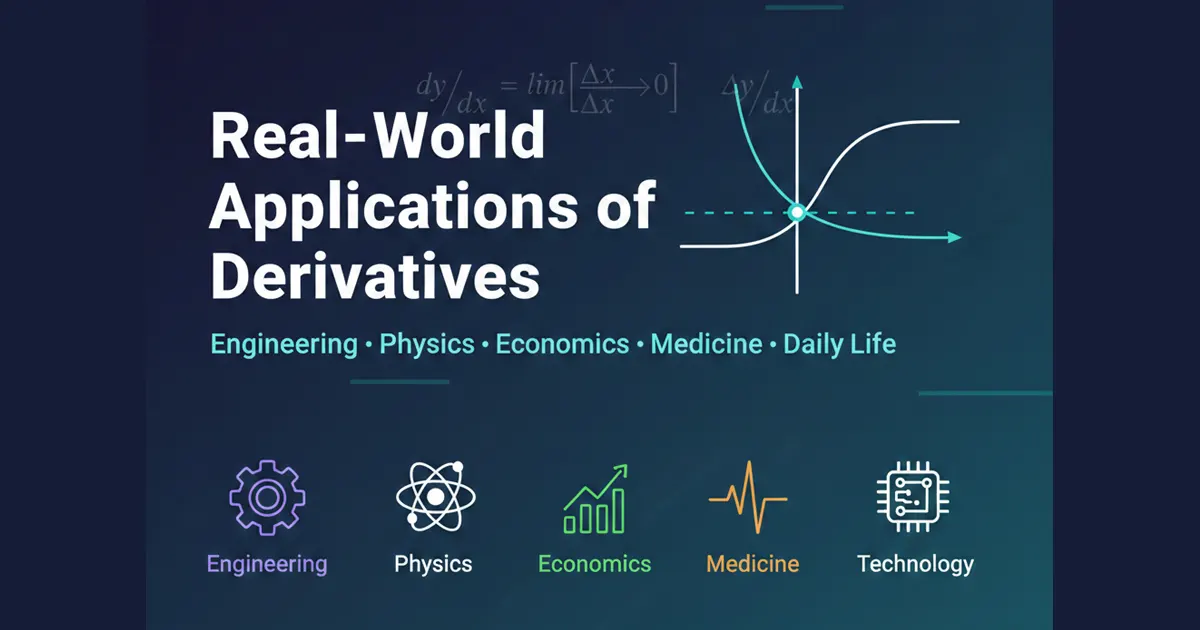
🎯 Why Derivatives Matter in the Real World
A derivative is the instantaneous rate of change of a function with respect to a variable.
Written as f'(x) or dy/dx, a derivative tells you how fast something is changing at any given moment — the mathematical foundation behind velocity, growth rates, optimization, and thousands of real-world applications.
Derivatives are the mathematical language of change. Every time something changes—whether it's a car accelerating, a stock price fluctuating, a building bending under load, or a drug concentration decreasing in the bloodstream—derivatives describe that change mathematically. This comprehensive guide explores how derivatives transform abstract mathematical concepts into practical tools that power modern technology, engineering, medicine, and economics.
Derivatives serve as the bridge between theoretical mathematics and practical problem-solving. They answer questions like: How fast is this car going? How quickly is the temperature rising? What's the optimal production level for maximum profit? How much will this bridge deflect under traffic? By mastering derivatives, you gain the ability to analyze, predict, and optimize real-world systems.
From Newton's laws of motion to modern machine learning algorithms, derivatives have been fundamental to scientific and technological progress for over 300 years. Today, they're embedded in everything from GPS navigation and smartphone sensors to medical imaging and financial trading algorithms.
Derivatives measure the rate of change of any quantity. In the real world, they are used in:
- ⚙️ Engineering — beam design, motion, circuits
- ⚛️ Physics — velocity, force, electromagnetism
- 📈 Economics — profit maximization, cost analysis
- 🏥 Medicine — drug dosing, heart rate analysis
- 📱 Daily Technology — GPS, smartphones, thermostats
- 🤖 AI & Machine Learning — gradient descent, neural networks
This guide covers 25+ applications with 50+ worked examples and 3 interactive worksheets. Scroll down to explore each field in detail.
📋 Complete Table of Contents
1. Read through the applications that interest you most
2. Try the examples with our calculator tools
3. Download worksheets for practice
4. Apply concepts to real situations you encounter
5. Bookmark this page for future reference
1. Engineering Applications of Derivatives
Engineering transforms mathematical concepts into real-world solutions. Derivatives are fundamental to every engineering discipline, providing tools to analyze, design, optimize, and control systems. From the smallest microchip to the largest bridge, derivatives ensure safety, efficiency, and functionality.
📌 Key Takeaway: Engineers use derivatives every single day to ensure buildings don't collapse, engines run efficiently, and electronic circuits behave predictably.
1.1 Civil & Structural Engineering
Civil engineers use derivatives extensively in structural analysis, ensuring buildings, bridges, and infrastructure can withstand loads and environmental forces.
A simply supported beam of length L = 6m carries a uniformly distributed load w = 15 kN/m. The maximum deflection occurs at the center:
Engineering Decision: The beam deflects 253.125mm, exceeding the 24mm code limit by more than 10 times. The engineer must: 1) Increase beam depth (increases I), 2) Use stronger material (higher E), or 3) Add additional supports. This demonstrates how derivatives inform critical safety decisions.
1.2 Mechanical Engineering
Mechanical engineers rely on derivatives for motion analysis, vibration control, thermal management, and material strength.
Fundamental Motion Relationships
A piston in an engine follows simple harmonic motion. At 3000 RPM, find maximum velocity and acceleration:
Engineering Significance: The piston reaches speeds of 18.3 m/s (66 km/h) and accelerations of 6579 m/s² (670g). These extreme values explain why engine components require high-strength materials and precise balancing. Without derivative analysis, engines would fail prematurely.
1.3 Electrical Engineering
Electrical systems fundamentally depend on derivatives through capacitor and inductor behavior.
Fundamental Circuit Relationships
These relationships make derivatives essential for analyzing AC circuits, filters, control systems, and power electronics. The time constant τ = RC or τ = L/R determines how quickly circuits respond to changes.
Smartphone touchscreens detect dC/dt (capacitance change rate) to sense finger position. Switched-mode power supplies use high di/dt switching to achieve 90%+ efficiency. Electric vehicle charging systems monitor dV/dt to optimize charging curves and battery life.
1.4 Aerospace Engineering
Aerospace engineers use derivatives for trajectory optimization, stability analysis, and aerodynamic design.
A rocket with initial mass 50,000 kg burns fuel at 200 kg/s. Exhaust velocity is 3000 m/s. Find acceleration after 60 seconds:
Aerospace Application: After 60 seconds, the rocket accelerates at 5.98 m/s² (0.61g) with acceleration increasing at 0.083 m/s³. This derivative-based analysis helps determine structural loads, fuel requirements, and mission profiles. SpaceX's Falcon 9 performs similar calculations 100+ times per second during landing.
1.5 Chemical Engineering
Chemical processes involve derivatives through reaction kinetics, heat transfer, and mass transport.
Chemical Engineering Fundamentals
These derivative-based equations allow chemical engineers to design reactors, optimize processes, and ensure safety in chemical plants.
Pharmaceutical manufacturing uses derivative-based kinetic models to optimize drug synthesis. A 1% yield improvement can save millions annually. Petrochemical plants use dT/dt monitoring to prevent runaway reactions that could cause explosions.
Summary: Engineering applications demonstrate that derivatives are not abstract mathematics but practical tools that ensure safety, efficiency, and innovation across all engineering disciplines.
2. Physics Applications of Derivatives
Physics studies how the universe changes—from the motion of planets to the behavior of subatomic particles. Derivatives provide the mathematical framework to describe these changes quantitatively.
📌 Key Takeaway: Every law of physics — from Newton's F=ma to Maxwell's electromagnetic equations — is expressed using derivatives.
2.1 Classical Mechanics
The foundation of classical mechanics is built on derivatives:
Newtonian Mechanics
2.2 Thermodynamics
Thermodynamics studies heat and temperature changes, fundamentally involving derivatives:
Thermodynamic Relationships
These derivatives allow calculation of heat capacities, expansion coefficients, and relationships between thermodynamic properties.
2.3 Electromagnetism
Maxwell's equations, the foundation of electromagnetism, are differential equations involving derivatives:
Maxwell's Equations
These partial derivatives describe how electric and magnetic fields change in space and time, enabling technologies from motors to wireless communication.
2.4 Quantum Mechanics
Quantum mechanics fundamentally involves derivatives through the Schrödinger equation:
Schrödinger Equation
Where ∇² is the Laplacian operator involving second derivatives. This equation determines the probability distribution of quantum particles.
Particle accelerators like the LHC use derivatives to calculate particle trajectories. Medical imaging (MRI) relies on derivatives of magnetic fields. GPS systems use derivatives of relativistic time dilation for precise positioning.
A satellite in circular orbit at altitude 400 km. Find orbital speed and period:
Physics Application: The International Space Station orbits at approximately these parameters (7.66 km/s, 92 minutes). These derivative-based calculations ensure satellites maintain proper orbits and enable precise positioning for communications, weather monitoring, and GPS.
Summary: Physics applications show that derivatives are the mathematical language of physical reality, describing everything from planetary motion to quantum probability.
3. Economics & Business Applications
Economics studies how individuals, businesses, and societies allocate scarce resources. Derivatives provide tools for optimization, marginal analysis, and predicting economic behavior.
📌 Key Takeaway: When a business asks "how many units should we produce?", the answer always comes from setting a derivative equal to zero.
3.1 Marginal Analysis
The cornerstone of microeconomics is marginal analysis—examining the effects of small changes:
Marginal Concepts
Where q is quantity produced/sold, C is cost, R is revenue, P is profit, and U is utility. These derivatives inform production decisions and pricing strategies.
3.2 Optimization in Economics
Businesses optimize by finding where derivatives equal zero:
A company faces demand curve P = 100 - 0.5Q and cost function C = 200 + 20Q. Find price and quantity for maximum profit:
Business Decision: The company should produce 80 units, price them at $60 each, for maximum profit of $3000. This derivative-based analysis informs pricing, production, and marketing decisions for businesses worldwide.
3.3 Macroeconomic Applications
At the national level, derivatives describe economic growth and stability:
Macroeconomic Derivatives
Central banks monitor these derivatives to guide monetary policy. Financial institutions use derivative-based models for risk management and option pricing.
The Black-Scholes option pricing model uses partial differential equations involving derivatives. Value-at-Risk (VaR) calculations use derivatives of portfolio value with respect to market factors. Algorithmic trading uses derivatives to predict price movements.
3.4 Economic Modeling
Advanced economic models use systems of differential equations:
Summary: Economics applications demonstrate that derivatives provide rigorous tools for decision-making, from individual consumer choices to national economic policy.
4. Medical & Biological Applications
Modern medicine increasingly uses mathematical models to understand biological processes, optimize treatments, and develop new therapies. Derivatives quantify rates of change in physiological systems.
📌 Key Takeaway: The difference between a safe drug dose and a dangerous one is calculated using derivative-based pharmacokinetic models.
4.1 Pharmacokinetics
The study of drug movement through the body involves derivatives:
Pharmacokinetic Models
Where C is concentration, k are rate constants, [S] is substrate concentration. These models determine dosing regimens and predict drug effects.
A drug follows first-order elimination with k = 0.1 hr⁻¹. Initial concentration is 200 mg/L. Find time to reach therapeutic window of 50-100 mg/L:
Medical Application: The drug remains in the therapeutic window for approximately 7 hours, with a half-life of 6.9 hours. This informs dosing frequency—likely every 6-8 hours. Such derivative-based calculations ensure effective treatment while minimizing side effects.
4.2 Physiology & Biomechanics
Derivatives quantify physiological processes:
4.3 Medical Imaging
Advanced imaging techniques use derivatives:
Imaging Mathematics
Where M is magnetization, B is magnetic field, T are relaxation times. These derivatives enable non-invasive diagnosis and treatment monitoring.
4.4 Epidemiology
Disease spread modeling uses derivatives:
SIR Model
Where S = susceptible, I = infected, R = recovered/recovered, β = transmission rate, γ = recovery rate. This model informed COVID-19 response strategies worldwide.
Cancer growth models use dV/dt = rV ln(K/V) (Gompertz growth). Drug discovery uses QSAR models with partial derivatives of molecular properties. Biomechanics uses derivatives to analyze gait and design prosthetics.
Summary: Medical applications show that derivatives provide quantitative tools for understanding life processes, developing treatments, and improving healthcare outcomes.
5. Daily Life Applications
Even if you never solve a derivative equation, derivatives impact your daily life through technology, transportation, finance, and consumer products. Understanding derivatives helps you make better decisions and appreciate the technology around you.
📌 Key Takeaway: Your smartphone uses derivatives 1000+ times per second — in the accelerometer, GPS, battery management, and touchscreen sensors.
5.1 Transportation
5.2 Technology & Electronics
5.3 Home & Environment
5.4 Personal Finance
A house cools according to Newton's Law of Cooling: dT/dt = -k(T - T_outside). Find optimal thermostat setting:
Practical Application: The thermostat should cycle approximately every 3.35 hours, heating for 40 minutes then off for 2.7 hours. This minimizes energy use while maintaining comfort. Smart thermostats perform similar derivative-based calculations continuously.
From the moment your alarm clock wakes you (timing involves rates of change) to when you fall asleep (circadian rhythms involve biological derivatives), your day is filled with applications of derivatives. Understanding these concepts helps you make better decisions, save money, and appreciate the technology that makes modern life possible.
Summary: Daily life applications demonstrate that derivatives are not just academic exercises but practical tools embedded in the technology and systems we use every day.
6. Free Derivative Calculators
Use these interactive tools to solve derivative problems instantly. Perfect for verifying your solutions and practicing applications:
1. Try examples from this guide to verify your solutions
2. Experiment with different functions to build intuition
3. Use step-by-step mode to understand the process
4. Check your worksheet answers against calculator results
5. Explore edge cases to deepen understanding
7. Interactive Worksheets
Practice real-world derivative problems with these comprehensive worksheets. Each includes 10+ problems with detailed solutions, available to view online, print, or download.
- Step-by-step solutions with explanations
- Real-world problem scenarios
- Multiple difficulty levels
- Printable format with answer keys
- Downloadable PDF versions
- Designed for self-study or classroom use
8. Detailed Examples
These detailed examples demonstrate how to apply derivative concepts to solve complex real-world problems across different domains.
Example 1: Bridge Cable Analysis (Civil Engineering)
A suspension bridge cable follows the catenary curve y = a cosh(x/a) - a, where a = 100 m. At point x = 50 m from the lowest point, find:
- The slope of the cable
- The tension components if total tension is 5000 kN
- The rate of slope change (curvature)
Engineering Interpretation: At x = 50m, the cable slopes at 27.5° with tension components of 4435 kN horizontal and 2309 kN vertical. The curvature is 0.0113 m⁻¹ with radius 126.8 m. These calculations ensure the cable can support the deck weight without excessive sag or stress.
Example 2: Economic Production Optimization
A factory produces goods at rate P(L) = 100L - 5L², where L is labor in worker-hours. Labor costs $20/hour. Goods sell for $50 each. Find:
- Optimal labor input for maximum profit
- Maximum profit
- Marginal product and marginal revenue product at optimum
Business Decision: The factory should use approximately 10 worker-hours for maximum profit of $24,800. At this point, marginal product is zero, meaning additional labor doesn't increase output—the production function exhibits diminishing returns. The marginal revenue product equals the wage rate ($20), satisfying the profit-maximizing condition MRP_L = w.
Example 3: Medical Drug Concentration
A drug is administered intravenously at rate 2 mg/hour. It follows two-compartment pharmacokinetics:
Medical Significance: At steady state, central compartment concentration is 10 mg/L and peripheral compartment is 20 mg/L, with total body drug of 30 mg. This informs dosing regimens—to maintain therapeutic levels, infusion should continue at 2 mg/hour. The peripheral compartment acts as a reservoir, explaining why some drugs have long elimination times despite short central compartment half-lives.
These comprehensive examples demonstrate the problem-solving process: 1) Understand the real-world scenario, 2) Translate to mathematical model, 3) Apply derivative concepts, 4) Interpret results in practical terms. Practice with our worksheets to develop these skills.
People Also Ask About Derivatives
9. Frequently Asked Questions
Explore our other resources: Derivative Rules Guide, Practice Problems, Visual Explanations, and All Calculators.
📚 Continue Learning — Related Pages
Explore these related resources to deepen your understanding of derivatives and their applications:
🚀 Master Real-World Derivatives Today!
Use this comprehensive guide, interactive worksheets, and calculator tools to become confident in applying derivatives to real problems. Start your journey to mathematical mastery!
📌 Key Takeaways & Next Steps
- ✅ Derivatives quantify change across all disciplines
- ✅ Engineering applications ensure safety, efficiency, and innovation
- ✅ Physics applications describe motion, forces, and fundamental laws
- ✅ Economics applications optimize decisions and model behavior
- ✅ Medical applications improve treatment and understanding
- ✅ Daily life applications are everywhere in modern technology
- ✅ Practical tools include calculators, worksheets, and examples
1. Beginner: Understand basic rate-of-change concepts
2. Intermediate: Apply derivatives to optimization problems
3. Advanced: Model complex systems with differential equations
4. Expert: Develop new applications in your field
Continue Your Mathematical Journey
Derivatives are just the beginning. Explore integrals, differential equations, multivariable calculus, and their applications. Each mathematical concept opens new doors to understanding and solving real-world problems. Remember: mathematics is not about memorizing formulas but about developing problem-solving skills that apply across disciplines.
The most beautiful aspect of derivatives is their universality. The same mathematical concept that describes planetary motion also optimizes business profits, models disease spread, and designs smartphone sensors. By mastering derivatives, you gain a powerful lens through which to understand and improve the world around you.